

For many years, I was a workaholic. I had a terrible time disconnecting at the end of a work day. In fact, there was no real “end” or “beginning” to my work days. I’d often work whenever was most convenient for me because I wasn’t in an externally-facing role at my company and was also freelancing in my spare time. So my 9-5 was more like whenever-it-suited-me and my side hustle took up the extra time.
Even after my day job became more client-facing with more regular hours, I still had a hard time turning off my work mode. I’d feel guilty if I wasn’t constantly tethered to our work chat app, or readily available whenever my team might need me.
This was not a great look for me. Constantly stressed, always “on”, and unable to relax, I had trouble sleeping and felt that constant hum of anxiety percolating beneath the surface ready to spring into panicked action when triggered.
Working from home made it worse because my office, my work equipment, my connection to my colleagues, were all IN MY HOUSE, mere feet from wherever I may be during the day. When was the work day actually over? It felt like I was always in “work” mode, always “on”, always needing to be available. I never really LEFT work. I never WENT to work for that matter. WAS I ACTUALLY WORKING? Cue the guilt.
Eventually, my unhealthy devotion to work and constant work-related stress became a recurring topic in my therapy sessions and a common theme of my marital disagreements. This just wasn’t going to do. I finally cured myself of these toxic habits by setting strict boundaries between my work life and personal life.
Boundaries are important regardless of where you work — at home or in an office — but they are an especially crucial matter for remote workers whose homes function as places of business. For those of you who have suddenly found yourself working from home due to Covid-19, you no longer have an obvious distinction between your two lives, no commute to separate your personal time from your work time. Your morning routine is likely different. You may have even stopped showering as frequently. I imagine this sudden change in your day-to-day might be jarring, so if you want to mentally survive this apocalypse, you must create boundaries separating home from work to allow the appropriate change in mindset whether you’re going to or coming from work.
Here’s what has worked for me.
Create a time boundary.
The best change I ever made to cure myself of overworking was sticking to a strict end-of-day time boundary. I’m not talking about establishing a set 9-5 schedule (which I also recommend, and shouldn’t be hard if you already have an established in-office schedule). I mean saying that the minute you “leave work” for the day, commit to actually leaving work. When you work in the building, and leave for the day, you can mentally check out of your professional life and shift mental gears back to your family, loved ones, and personal life. You need to be able to do the same thing when working from home.
Commit to “going home” at 6 o’clock, or whatever time your day ends. After you get home, stay home. Don’t give in to the temptation… it’s easy to say, “I’ll just check email one more time” after you’ve already “left work” for the day. But once I stopped myself from doing this, and forced myself to stay in “home” mode once the clock hit 5, I felt so much better. Even if I thought of something that I needed to email someone or something I needed to research for a meeting, I would allow myself to make a small note as a reminder but I could not go into my office or get back on my computer. Work was done for the day. I was at home.
Commit to your time. After you’re done working, stop working. Switch on your “home” mode and let your personal time be personal.

Create a physical boundary.
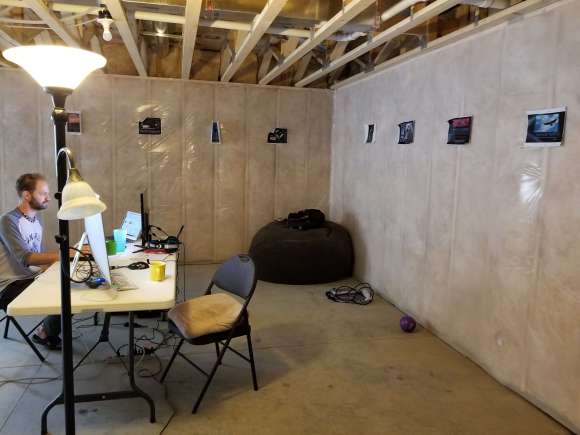
Ideally, you can create a separate office space somewhere in your home, preferably with a door that closes. If you do have an extra room or closet that you can designate as “the office” for the foreseeable future, then do so. Close the door for quieter Zoom meetings but also at the end of the day when you “leave work” (see Create a behavior boundary below).
For those of you who don’t have any spare rooms in your home, I still recommend that you select a physical location to call “the office”. It can be your dining room table, a corner of another room with a makeshift desk, the end of your kitchen counter, or the opposite end of the couch where your spouse usually sits. Best choose a location that other housemates don’t need access to during your work hours, and if you can, select an area that you can avoid or ignore when you’re “home” and not “at work”. Don’t sit in your favorite chair or at “your” spot at the dining room table. Choose a location that you don’t use for much else and stick to it every day.
You may already be accustomed to this if you ever work while traveling. During our 3-week Northeast road trip, I was still working half-days, so at every AirBNB or hotel, I had to establish “my office”. It might have been a coffee table or an actual desk tucked away in a corner, or it may have just been a pillow on the floor with my laptop balanced on a stack of books (it was only one day). When we lived in the Hague for a month, we shared the dining room table because it was more convenient working near the kitchen than up two flights of stairs in the office. But when we used the table for meals or games, I made sure to always sit in a different spot than I did while I was working.

Whatever your physical location is, claim it as work and treat it as such. When you are done for the day, literally walk away from the area, creating physical distance to remind yourself that you are now “home” for the evening.

My friend’s dining room became her office 
My mom’s office in their library 
My dad’s dedicated remote office 
My husband’s full-time remote office 
My husband’s temporary office at my parents’ house during the week we lived there post-tornado
Create a digital boundary.
It’s hard to disconnect in our always connected world. I am the first one to admit that I still struggle with this. But when I started enforcing strict digital boundaries, disconnecting from work when I wasn’t “at work”, my anxiety levels plummeted.
If you have two computers, use one for work and one for leisure. Don’t mix. Many of you likely have a work laptop or have brought home your work desktop so this should be relatively easy to do.
If you don’t have this luxury, create two separate workspaces on your computer. The simplest way to do this is to create two user accounts. Work and Personal. Install Slack on the Work account but not the Personal one. Don’t login to your work email on your Personal account. In the morning, login to your Work account. At the end of your work day, switch to your Personal account. For any apps that you may use between both work and home life, create separate user accounts with your work and personal emails. You could even go as far as to partition the hard drive of your multi-purpose computer keeping work files from mixing with fun files.
Turn off push notifications for email and chat apps on your phone. When working from home, you are unlikely doing your work from your phone, so don’t make it a work device. You won’t remember to turn things off at 5 pm and the constant dings and pings of email and Slack will disrupt the other boundaries you’ve established. I like to be able to access my email and chat apps from my phone so that if I have to be away from “the office” during the day, I can easily check in or be available to my team mates, but I have to manually check them. After I’m done for the day, no more checking.
Create a behavioral boundary.
For people who typically work outside the home, there is a whole ‘getting ready for work’ routine that remote workers just don’t have to do. Many opt to though, in order to create a boundary between “home” and “work” time, establishing a routine that accomplishes the same thing that a commute does: signals to your brain (and your house mates) that you are leaving home and going to work.

Even if your new commute is merely from the coffee pot to the dining room table or from your bedroom to the couch, do yourself a favor by maintaining a version of your previous ‘getting ready for work’ routine, or establishing a new one. Even a small morning ritual can become an effective way to switch your work mode “on”, such as making the coffee, brewing a cup of tea, or donning a specific hoodie.
Similarly, you need a boundary at the end of the day to signal to everyone (but mostly yourself, from my experience) that you are done working for the day, leaving the building (metaphorically) and going home. For me, that became the physical act of shutting my office door, but it can be anything. Closing your laptop and putting it in a drawer. Going down the driveway to check the mail. Taking a walk and listening to the podcast you usually enjoy on your drive home. Do something just for you, big or small, and do it every day, as if you were commuting home. It’ll become routine before you know it, and switching work mode “off” will be a breeze.
These are the things that work for me, that keep me sane while working remotely, whether I’m at home or traveling. I hope that they help you, especially if you’re new to working from home and trying to do so with everyone else in your family. Try one or all of them! You may find that something else works for you entirely.
The important thing is to find a way to create physical, digital and mental space between your work and personal lives so that you can turn your work brain off at the end of a long day and relax. For those who are working from home for the first time — surrounded by partners or pets or kids that you don’t usually spend so much time with — it’s especially important to find ways to keep your different stresses as separate as possible.
When you find something that works for you, share it with your fellow remote workers. There are way more of them these days than ever before! And we will get through this pandemic together…apart!
Discover more from No Place Like Anywhere
Subscribe to get the latest posts sent to your email.